The Ultimate Guide to POAS: Why POAS is the Metric That Actually Scales E-Commerce Profit


For years, digital marketing agencies and ad platforms have treated Return on Ad Spend (ROAS) as the holy grail of e-commerce performance. If your ROAS target looks high, you're winning - right? Not necessarily. In fact, relying solely on traditional ROAS might be actively blocking your profitability.
The issue lies in how the metric is practically applied. True "return" should mean profit. However, because net profit margins are complex and traditionally hidden from ad networks, Google and Meta swapped profit for the easiest data point available: revenue. As a result, traditional ROAS is actually Revenue on Ad Spend - and revenue tells you absolutely nothing about product margins, payment fees, shipping costs, or hidden overhead.
The core problem: three flawed ROAS tactics
To compensate for the lack of margin transparency, e-commerce brands typically deploy one of three traditional ROAS strategies. Every single one comes with built-in pitfalls.
Tactic 1: The average ROAS target
Brands look at their historical order data, calculate an average profit margin across the entire store, and set a single ROAS target. The pitfall: this is a "win some, lose some" gamble. You blindly accept losing money on low-margin orders as long as the overall average looks positive. It frequently leads to scaling ads for high-priced, zero-margin products while killing ads for cheap, high-margin items.
Tactic 2: The differentiated ROAS strategy
Products are divided into custom clusters - usually 3 to 5 tiers - based on their specific margins, with unique ROAS targets assigned to each tier. The pitfall: consumers rarely buy the exact product they clicked on. A shopper might click an ad for a product with a low ROAS target, but end up purchasing a cross-sell item with a much higher break-even requirement. On paper, the ad looks successful. In reality, you lost money on the order.
Tactic 3: The highest break-even ROAS
To guarantee they never lose money on an individual order, a brand identifies the lowest-margin product in their entire catalogue and applies its high break-even ROAS across the board. The pitfall: you place an aggressive, artificial ceiling on your growth. By demanding a massive ROAS for every single product, you choke the ad volume for items that could have comfortably and profitably scaled at a much lower ratio.
What is POAS?
POAS stands for Profit on Ad Spend. Instead of comparing ad costs against top-line revenue, POAS compares your ad spend directly against your gross profit.
POAS = Gross Profit / Ad Spend
Because this formula measures actual profit, the benchmark for success is completely transparent: any POAS score above 1.0 means your campaign is making money.
Want to see how your current campaigns look when factoring in real margins? Use our free POAS Calculator to calculate profit on ad spend instantly.
Why POAS outperforms ROAS: real-world scenarios
The example below shows how the outcome of the same four orders looks entirely different with ROAS compared to POAS. We apply Tactic 3 - highest break-even ROAS. The ROAS target is set slightly higher than the highest break-even ROAS among the four orders to ensure every order is profitable.
Notice the considerable variation in break-even ROAS. The vacuum bags only require a ROAS of 2.1 to break even, whereas the robot vacuum requires 8.4. This is not uncommon in e-commerce, where stores often carry high-profile branded products alongside private-label accessories.
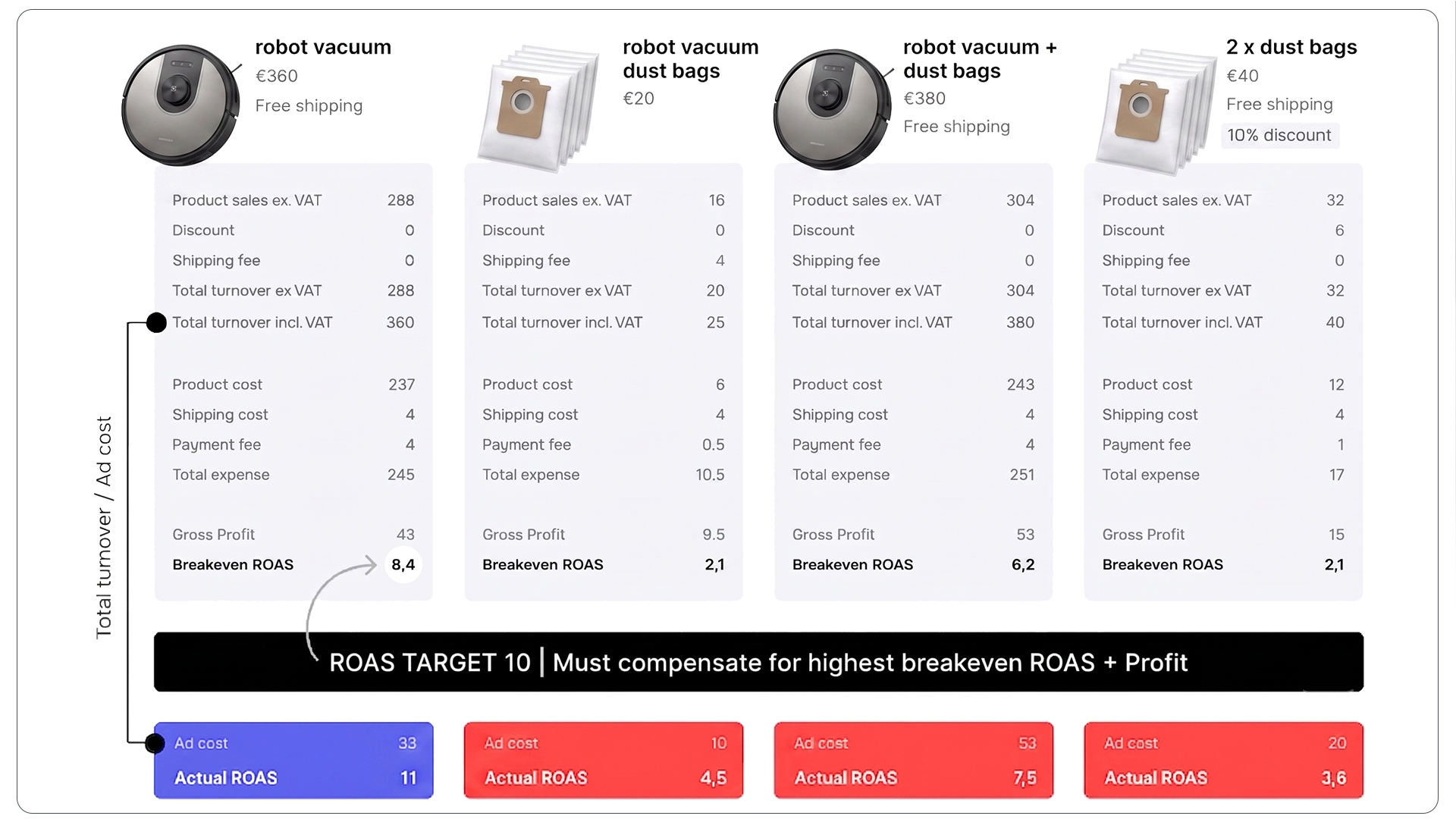
If we compare the ROAS target of 10 to the actual ROAS of the four orders, a responsible marketer would shut down advertising for three out of the four products. Now look at what happens when you switch to POAS as the key metric.
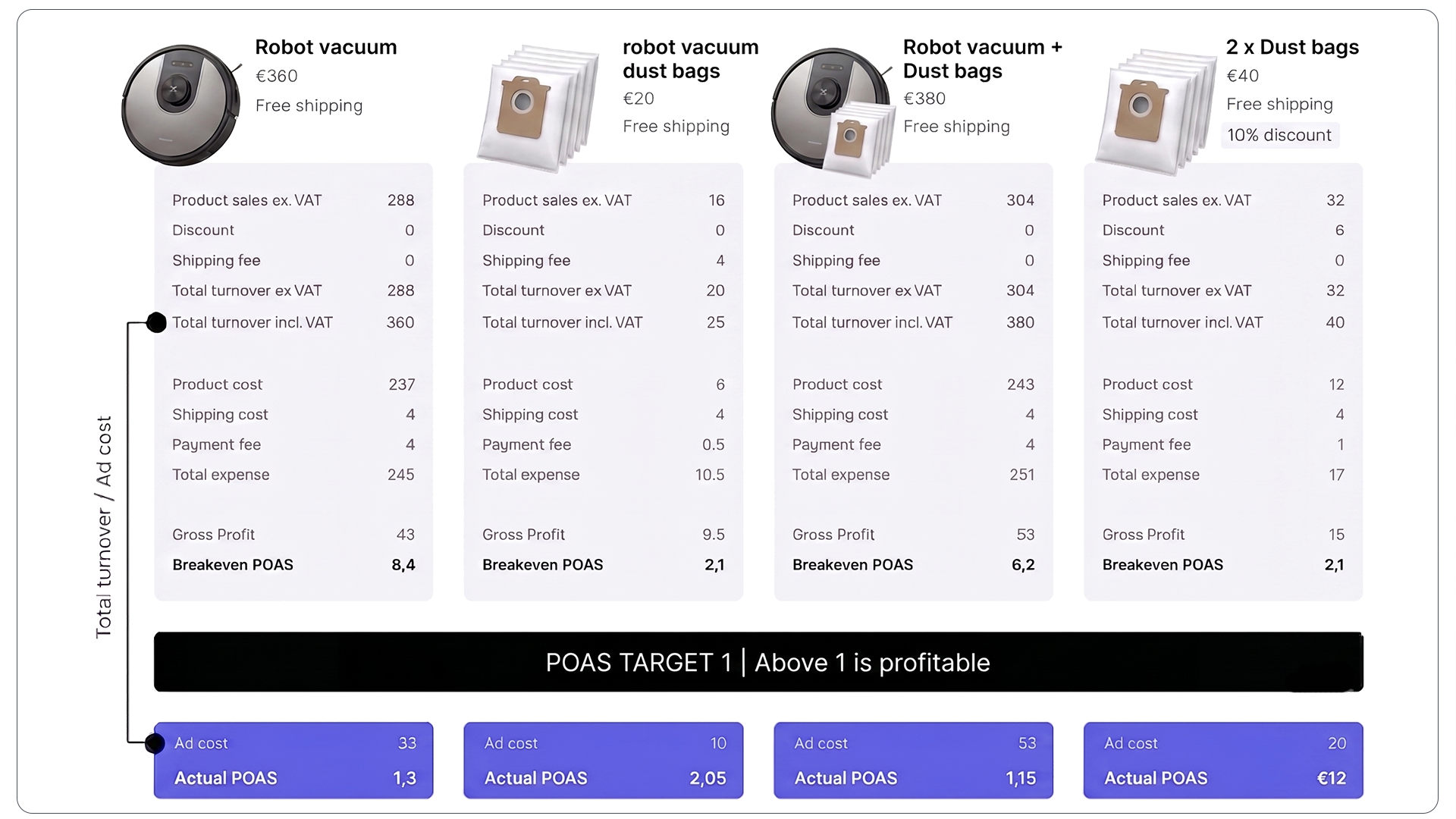
It turns out that all four orders are profitable. The three that would have been shut down using revenue-based ROAS are the most profitable of all - an insight that is impossible to get without real margin data.
You might say: "My margins don't vary much, so POAS is irrelevant to me." The answer is no. Variations in margins are just one of the factors accounted for by POAS. Other factors include product promotions, discount codes, variations in shipping costs, payment fees, and all the other variable costs of your business.
POAS with promotions: where ROAS completely breaks down
The example below uses running shoes and a running jacket with almost identical margins - but product promotions cause the break-even ROAS to shift dramatically. If you run continuous promotions, it becomes nearly impossible to keep track of and balance your ROAS targets across the catalogue.
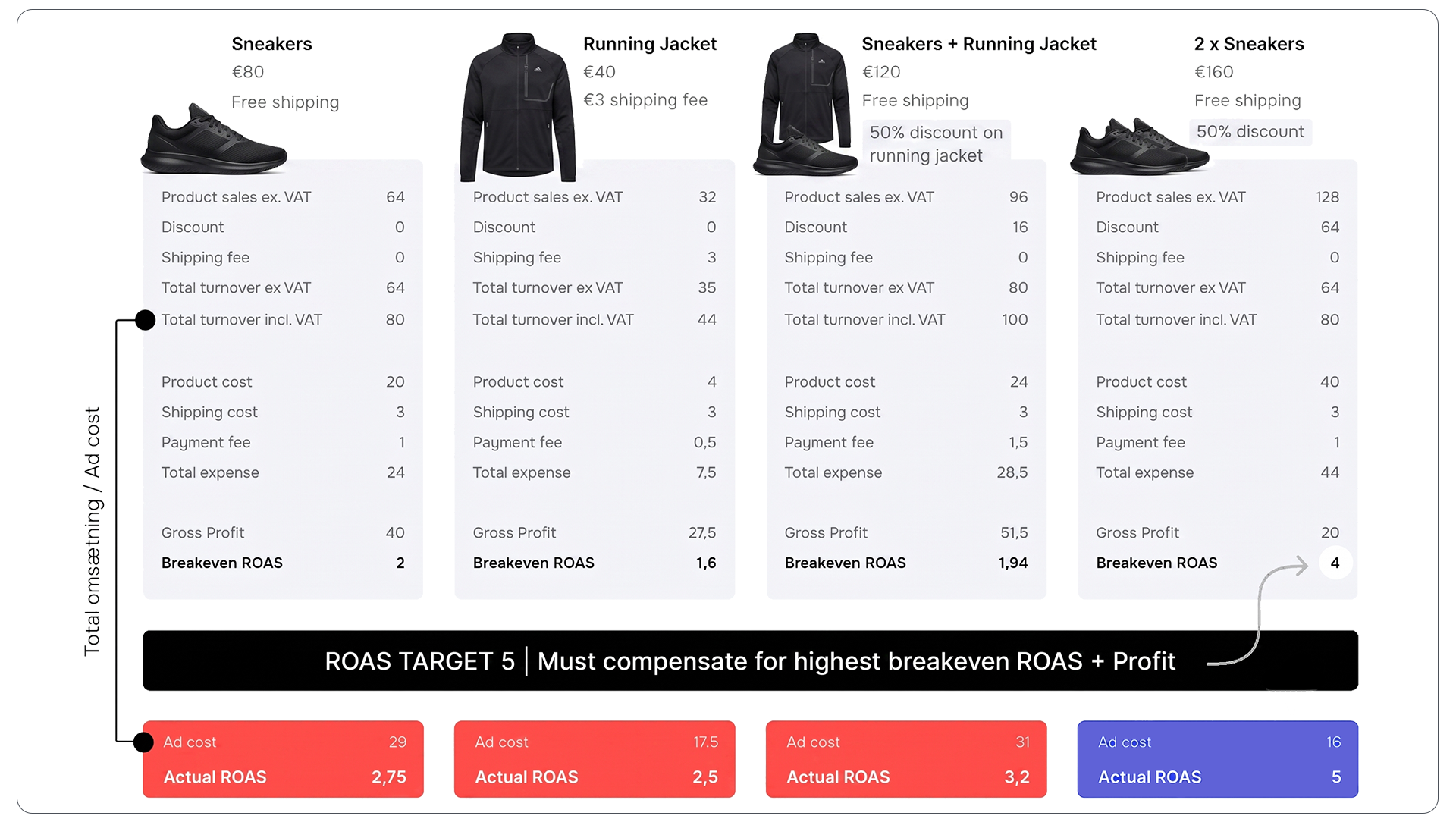
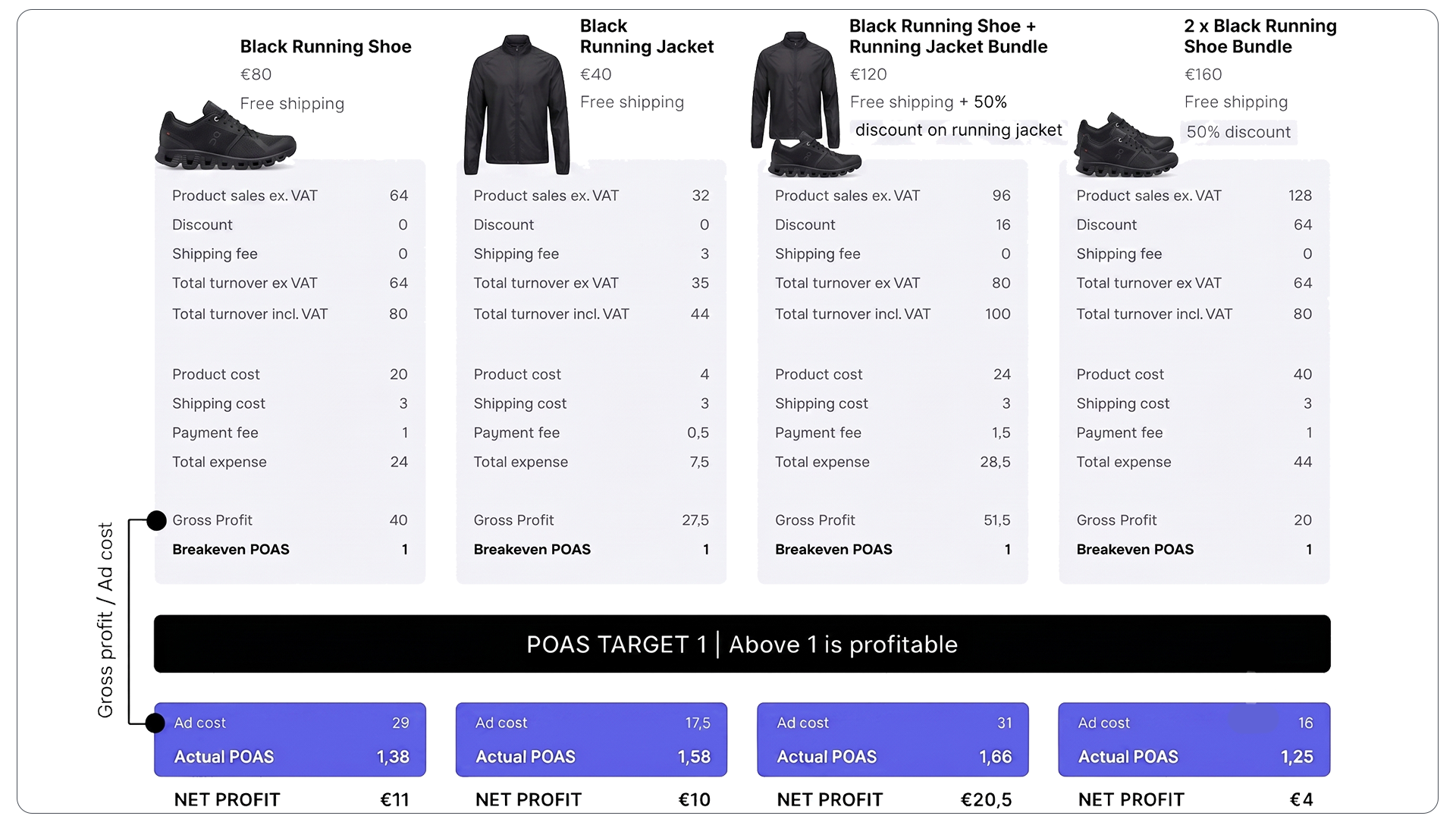
With POAS, you do not need to set special targets for promotions. As long as the order is above POAS 1, you have made money. All costs are considered, and you will not get any unpleasant surprises when the accountant reviews the numbers.
Activating profit data inside your ad accounts
The real power of POAS is realised when you feed gross profit data directly back into Google Ads and Meta Ads. By passing profit values instead of raw purchase revenue through your tracking pixels, you can transition your Smart Bidding and Advantage+ campaigns from revenue optimisation to profit bidding.
Instead of training algorithms to hunt down the biggest spenders, you train them to find the most profitable transactions. Brands transitioning to profit-bidding models regularly see significant drops in wasted ad spend while bottom-line earnings increase.
To implement this: pass gross profit as your conversion value in Google Ads via a dynamic conversion value in your checkout, or through the Enhanced Conversions API. In Meta, use the Conversions API to send gross profit per order as the revenue value. Once profit is your conversion value, set your target ROAS to 1x - because POAS break-even is always exactly 1, regardless of product or price point.
- -The definition: POAS measures gross profit generated per dollar spent on advertising, creating a definitive line for profitability.
- -The benchmark: A POAS above 1.0 mathematically guarantees the campaign made money after product costs.
- -The pitfall of ROAS: Traditional ROAS tracks revenue, which tricks algorithms into prioritising high-priced, low-margin products that drain capital.
- -Automation ready: Feeding POAS data directly into Google and Meta unlocks automated profit bidding, cutting wasted spend at scale.
Ready to calculate your POAS? Use our free POAS Calculator to factor in your margins, shipping, and transaction fees and see your true profit on ad spend.